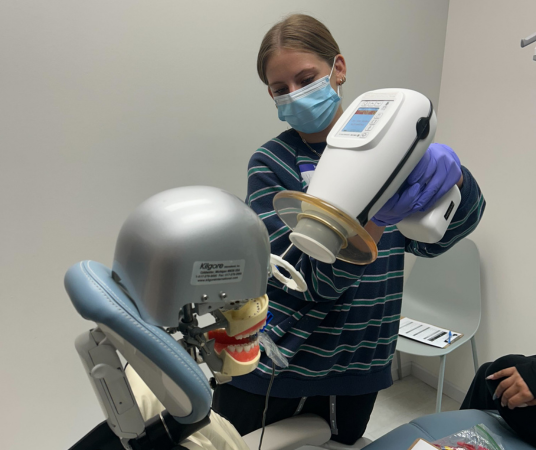
Most people assume preparing for a healthcare career takes years. For dental assisting, that assumption is wrong. A 12 week dental assistant program is enough time to go from no experience to trained, credentialed, and working in a dental office — if the program is designed well.
Here’s the honest case for 12-week training: what it covers, how it compares to longer programs, and whether it’s the right move for your situation in Austin.
Why 12 weeks works
The 12-week timeline isn’t arbitrary. It reflects deliberate curriculum design: remove everything that doesn’t directly apply to dental assisting, concentrate clinical practice into intensive weekly sessions, and get students ready to work as quickly as quality allows.
Longer programs — 1-year or 2-year community college options — cover the same core clinical and administrative dental content. The difference is everything else: general education requirements, longer semesters, scheduling gaps, and slower pacing. A focused 12 week dental assistant program cuts those extras without sacrificing the substance.
The result is faster, more affordable, and — for most dental assisting careers — just as effective.
What a 12-week program covers
Weeks 1–4: Foundations
- Dental anatomy and terminology
- Introduction to infection control and OSHA standards
- Sterilization procedures and PPE protocols
- Dental materials: impression materials, cements, and restorative materials
- Introduction to the dental operatory: setup, instruments, and equipment
Weeks 5–8: Clinical skills
- Chairside assisting — instrument passing, suction, retraction, and four-handed dentistry
- Dental radiography — taking bitewings, periapicals, and panoramic X-rays correctly
- Patient preparation, seating, and draping
- Managing patient medical histories and clinical emergencies
- Expanded functions where permitted by state: coronal polishing, fluoride application
Weeks 9–10: Administrative skills
- Appointment scheduling and patient flow management
- Dental charting and electronic health records (EHR)
- Insurance verification and basic billing codes
- HIPAA compliance and patient confidentiality
- Front office communication and professional conduct
Weeks 11–12: Externship and career preparation
- Supervised practice in a working dental office
- Resume building and professional portfolio
- Interview preparation and job search strategies
- Certification exam preparation: RDA, RHS, and ICE exams
What 12-week graduates look like in the job market
There’s a common concern that a shorter program means weaker preparation. What employers actually evaluate:
- Chairside skills — can you assist efficiently during a procedure?
- Radiography competency — can you take diagnostic-quality X-rays?
- Infection control — do you follow sterilization and OSHA protocols consistently?
- Professional attitude — are you reliable, coachable, and a good team fit?
- Certification — do you hold an RDA or equivalent credential?
A 12-week program that covers all of these well produces graduates who compete effectively in the job market. Many outperform graduates of longer programs who covered the same material at a slower, less intensive pace.
How it compares to longer programs
| |
12-Week Program |
6–12 Month Program |
2-Year Associate’s |
| Core clinical skills |
Covered |
Covered |
Covered |
| Admin training |
Covered |
Covered |
Covered |
| General education |
None (not required) |
Sometimes included |
Required |
| Cost |
Lower |
Moderate |
Higher |
| Time to first paycheck |
~3–4 months |
7–13 months |
2+ years |
| Credential |
Certificate + exam prep |
Certificate/diploma |
Associate’s degree |
The clinical and administrative training is comparable across program types. The differences are time, cost, and general education requirements — none of which affect your ability to work as a dental assistant.
Who this program is designed for
- Career changers who need to retrain without spending 1–2 years in school
- Working adults who want a realistic timeline for entering healthcare
- Recent graduates who want to start earning quickly
- Parents and caregivers managing family responsibilities alongside education
- Anyone without dental experience — the program is built from the ground up for beginners
Job outlook and salary
The Bureau of Labor Statistics projects **7% growth in dental assisting jobs from 2025 to 2035 — much faster than the average for all occupations. The national median salary is **$48,070 per year ($23.11/hour, May 2025), with entry-level positions typically starting around $37,000-$42,000 (estimate).
Completing a 12-week program means entering this job market 12–18 months earlier than graduates of longer programs. That’s a meaningful economic head start.
Get started in Austin
Austin Dental Assistant School offers a 12-week dental assistant program in Austin with hands-on clinical training, externship placement in local offices, and career support included.